

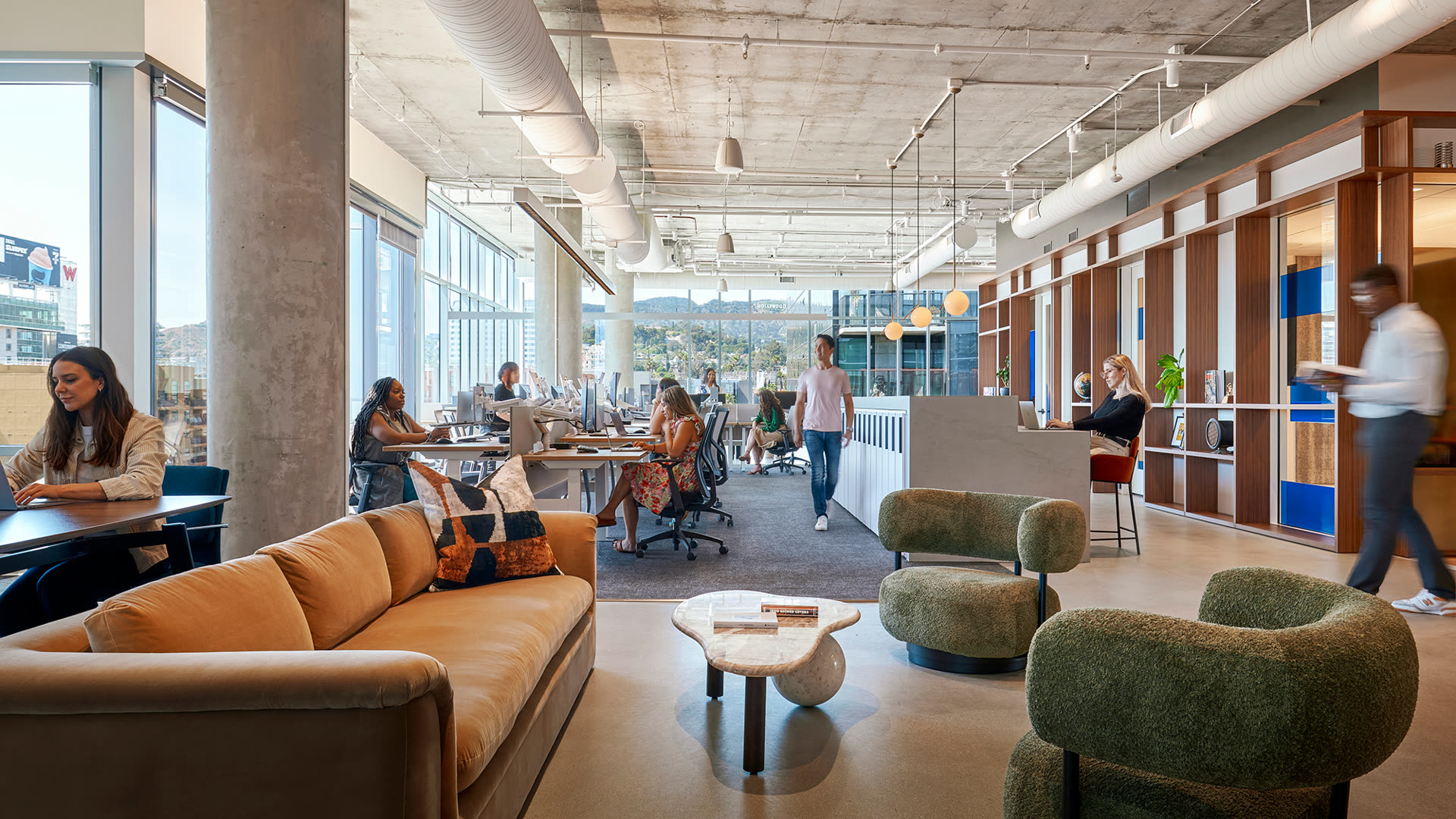
12 — Workplace Strategy & Experience Consulting
Culture is built on workplace strategy.
Solutions tailored to each client’s needs, preferences and personality — improving the current and future productivity of your people.
Make real estate your competitive advantage.
- Space designed for five days a week that now sits partly empty
- A hybrid policy that was set quickly and has never been designed for
- An upcoming move, consolidation or fit-out — the moment the model can change
- Difficulty attracting or retaining talent where the workplace is part of the reason
Culture is built on workplace strategy. As leading workplace and human-experience specialists, we tailor solutions to each client’s needs, preferences and personality — improving the current and future productivity of your people.
A workplace either helps people do their best work or quietly taxes them for showing up. Most offices were designed for an operating model that no longer exists — five days a week, assigned desks, meetings that all happened in one room — and the mismatch shows up as empty space, frustrated teams and a commute nobody can justify.
Workplace strategy is the work of matching the space to how the organization actually operates. It precedes design: what gets built should follow from how people work, what the culture is trying to be, and what the business is paying for.
The work, itemized.
Current-state assessment
How the existing space is used, what it costs, and where it works against the way people actually operate.
Utilization study
Real occupancy and space-use data rather than assumptions about attendance.
Employee engagement
Surveys and interviews to understand what supports and obstructs the work, by team and by function.
Operating model design
Remote, hybrid and on-site balance defined deliberately, with the space implications made explicit.
Space programming
The mix of desks, collaboration, focus and specialist space the model actually requires.
Experience strategy
The amenities, services and environment that make the workplace worth the commute.
Change management
Communication and rollout, so a new workplace is adopted rather than resisted.
Post-occupancy measurement
Measuring the result against the intent, and adjusting.
Four stages, in order.
What clients ask first.
What is workplace strategy?
The work of deciding how and where an organization’s people should work, and translating that into a space requirement. It sits ahead of design — it decides what should be built rather than how it should look.
How do you measure whether space is working?
A combination of utilization data — how intensively space is actually occupied — and direct input from the people using it. Both matter: usage shows what happens, engagement explains why.
Can workplace strategy reduce cost?
Often, but reducing footprint is a possible outcome rather than the objective. The aim is space that supports the work; sometimes that is less space, and sometimes it is the same space configured very differently.
When is the right time to do this?
Ahead of a move, consolidation or fit-out, because that is when the model can actually change. It is also worth doing independently when a hybrid policy was set in a hurry and never designed for.
Do you handle the design and construction too?
Workplace strategy defines the requirement; our project management team delivers it. Keeping those connected is what stops the intent getting lost between strategy and construction.